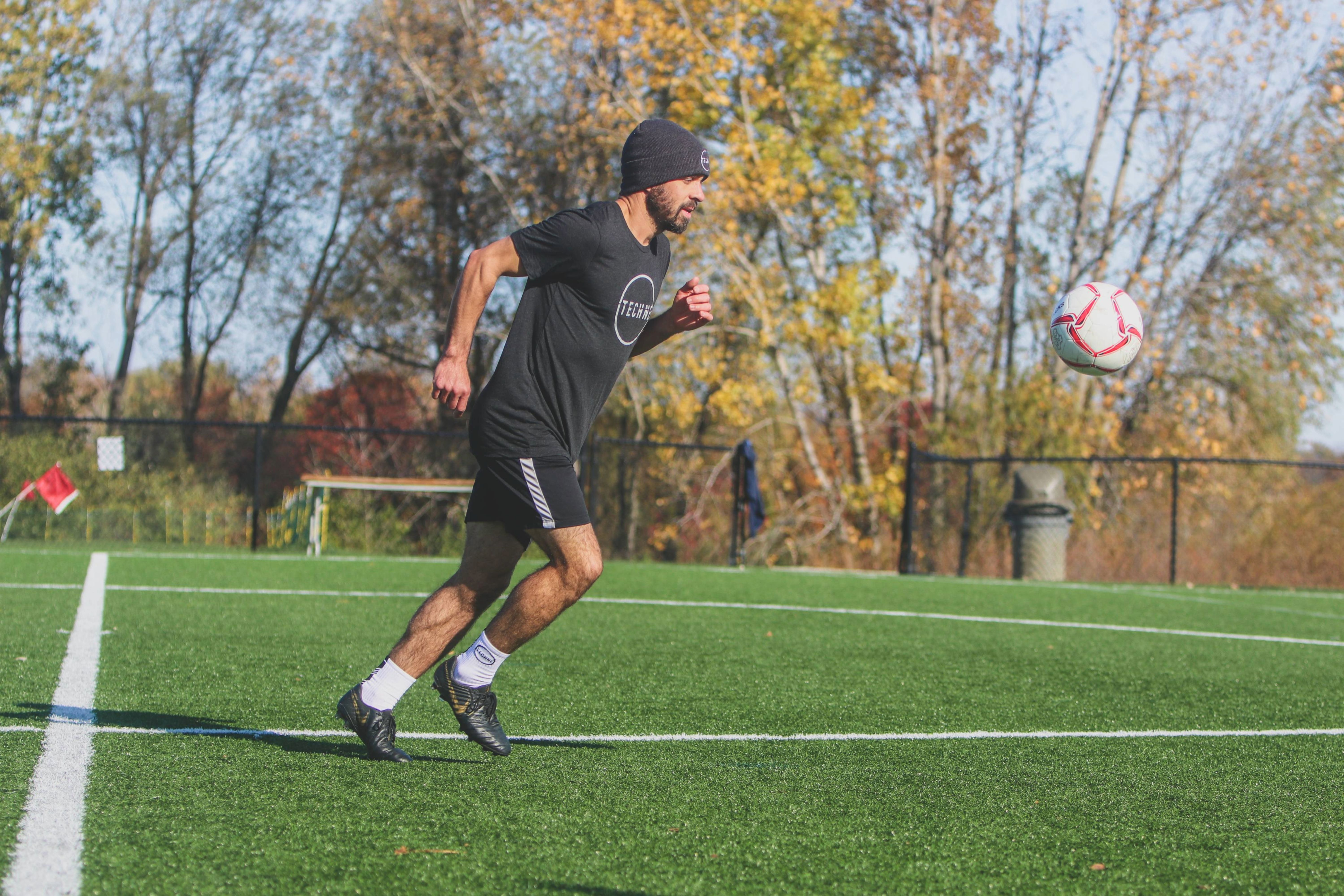
Dribbling is moving with the ball under control, and it is one of the first and most important skills in soccer. You need to be able to carry the ball and change direction at any time. But great dribblers are not just the players with the fanciest moves. They know when and where to dribble: there are moments when dribbling is the best option, and moments when it is far riskier than a pass. The more you watch soccer with an eye on the game, the better you will recognize the difference.
The most useful way to think about dribbling is by what you are trying to do in the game. There are three types of dribbling you will need in every match. Not every great dribbler is great at all three. As you train and play you will find one or two that are your strengths, so build on those while you work on the rest.
The 3 types of dribbling you’ll need in a game
1. Getting out of pressure
When a defender is closing you down, or two or three of them are, there are a number of ways to break that pressure. Maneuvering with the ball in tight spaces to free yourself up is possibly the most useful type of dribbling there is. The more comfortable you are with the ball at your feet, and the more natural it is to use every surface of both feet, the better you will be at escaping pressure no matter how, where or when it arrives. This matters for every position on the field.
Drills to improve getting out of pressure
Building strength, balance and comfort on the ball
Footwork patterns to make moves second nature
Maneuvering around fake defenders
Players to watch: David Silva, Tobin Heath.
2. Running at players to beat them
Perhaps the most difficult type of dribbling is running at a defender with the ball and going past them with the ball still under control. Attacking players use it most. It is what most people picture when they think of a great dribbler, but it is actually the least frequently used type, because it carries the biggest risk of losing the ball. It takes fewer fancy moves and more of an understanding of how to change speed, and how to use your upper body, not just your feet, to shift the defender’s weight. One of the six moves every player should learn, dribbling with the sole, is built for this.
Drills to improve running at players
Running with the ball at speed
Moving forward with the ball while shifting it laterally
Players to watch: Kylian Mbappé, Rose Lavelle.
3. Freeing up space for a pass or shot
The type of dribbling used most often in a game is moving the ball to create space to pass or shoot. Again, this rarely needs fancy moves. It needs balance, coordination, the ability to change the ball’s direction quickly, and the use of your upper body to get the defender off balance. A change of speed or a faked pass or shot frees up space very effectively. And remember, you don’t need to completely beat your defender to make a quality pass or take a good shot. One foot-length of separation is enough for the ball to get through.
Drills to improve this
Players to watch: Frenkie de Jong, Debinha.
You will see dribbling broken down in other ways too: by speed, by which surface of the foot you use, or by individual moves. We organize it by what you are trying to do in the game, because that is the decision you face with the ball at your feet.
How to get better at dribbling
Touch the ball every day. Ten minutes of ball mastery, with both feet and every surface, does more for your dribbling than an hour of 1v1s once a week. Practice with your head up so you can see the defender and the space. Then take it to the game: the drills above and the dribbling section of each week’s new session in the Techne app give you the reps.
A huge part of dribbling is confidence. You can’t be scared to make a mistake. Read more on how to build soccer confidence. At the end of the day, your confidence comes from the work you put into training. Dribbling is fun to practice, and it is the part of the game that lets you show your creativity on the field.
Download the Techne app
Guided soccer sessions designed by pros, a plan to follow and a record of every rep. 7-day free trial, no card needed. Use code BLOG in the app for 10% off your first purchase.
Start your free trial